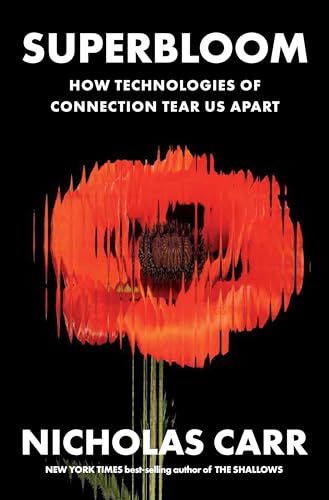
Superbloom Book Summary
How Technologies of Connection Tear Us Apart
Book by Nicholas Carr
Summary
With rich psychological insights and vivid examples drawn from history and science, Superbloom provides both a panoramic view of how media shapes society and an intimate examination of the fate of the self in a time of radical dislocation. It may be too late to change the system, Carr counsels, but it’s not too late to change ourselves.
The Superbloom: Media's Intoxicating Effect
In 2019, a rare superbloom of poppies in Walker Canyon, California attracted hordes of Instagram influencers and their followers. What began with one photogenic woman in orange overalls quickly spiraled into "Flowergeddon," with thousands trampling the delicate ecosystem for the perfect selfie.
This incident perfectly encapsulates our frenzied information-saturated era: the thrill of communal discovery, the toxicity of mob action, the democratization of media production, the cult of engagement, and most tellingly, the inability to experience nature directly without mediation through screens. We have subordinated genuine experience to the pursuit of digital validation.
Section: 1, Chapter: 1
Communication As A Moral Force
Throughout Western history, we've maintained an almost religious faith that communication is inherently good—that the sharing of information breeds empathy and understanding, mends divisions, and calms strife. Communication is seen not just as what makes us special as humans, but as a universal remedy for personal and social problems.
This belief has driven us to relentlessly pursue greater efficiency in communication—increasing its speed, volume, and reach. Paradoxically, the evidence suggests our faith has been misplaced. Despite unprecedented ability to exchange information, the twentieth century was history's bloodiest. The First World War began with a flurry of hasty telegraph and telephone messages that overwhelmed traditional diplomacy, demonstrating that communication can actually impede understanding rather than facilitate it.
Section: 1, Chapter: 1
The Public Interest Versus Private Platforms
For most of the 20th century, media was governed by a bipartite regulatory framework reflecting the distinct roles of different communication systems. Personal correspondence through mail, telephones, and telegrams was protected by the secrecy-of-correspondence doctrine. Broadcasting was regulated by the public-interest standard, which recognized that access to airwaves was a privilege requiring service to the community.
The internet dismantled this framework. When the Supreme Court struck down an anti-obscenity provision for the internet in 1997, Justice Stevens reasoned that the web wasn't like broadcasting since users "seldom encounter content accidentally." This decision exempted internet platforms from public interest obligations while also abandoning privacy protections. The result: a communication system with unprecedented reach operating with minimal accountability to society.
Section: 1, Chapter: 2
The Architectural Collapse Of Media
Before digitization, analog media created an "epistemic architecture" that helped people distinguish between different types of information:
- Different physical forms (letters, newspapers, books, TV, radio) created natural boundaries between types of content
- Specialized devices reinforced these boundaries (you couldn't take photographs with a telephone)
- The physical nature of media imposed natural friction on information flow
- Different regulatory regimes governed different media types
This architectural separation helped maintain communication's human scale by preventing electronic networks from overwhelming people's sense-making capacities. Digitization has collapsed these distinctions, forcing all information through a single channel with a single objective: maximizing engagement.
Section: 1, Chapter: 3
Content Is Not Cargo
Claude Shannon, the engineer whose mathematical theory of communication revolutionized information technology, famously declared: "The semantic aspects of communication are irrelevant to the engineering problem." In other words, meaning is separate from mechanism—a letter was both a message and a piece of cargo.
This distinction held firm throughout most of the 20th century, but has now evaporated. With the rise of algorithmic content selection and now AI-generated content, machines not only transport information but decide what information we see and even create it themselves. Signal processing has become semantic processing.
When Shannon proposed compressing transmissions by removing redundant information, he assumed machines would do this mechanically. With social media, we ourselves perform this compression, creating abbreviated language and reducing nuance to fit the medium's demands.
Section: 1, Chapter: 3
The News Feed Revolution
Facebook's introduction of the News Feed in 2006 marked a fundamental transformation in how information flows through society. Before the feed, Facebook consisted of static profile pages that users deliberately navigated between. The News Feed transformed this into a continuous, automatically curated stream of content.
This shift represented Facebook's desire to eliminate what Zuckerberg called "friction" in communication. Posts no longer needed to be actively sought out—they were algorithmically delivered to users. The algorithm made editorial decisions without regard to meaning, selecting whatever patterns of information it calculated would grab and hold attention.
As Zuckerberg explained in a revealing admission: "A squirrel dying in front of your house may be more relevant to your interests right now than people dying in Africa." This epitomizes content collapse—all information belongs to a single category of "content" competing for the scarce resource of attention.
Section: 1, Chapter: 3
The Sins Of Intermediation
Social media's industrial-scale moderation programs reveal the platforms' inability to manage the content they distribute. Despite employing thousands of content reviewers who follow elaborate rulebooks detailing acceptable content ("crushed heads" allowed, "internal organs" banned), platforms continue to spread harmful material.
This moderation crisis exposes the fundamental paradox of social media: the systems promote disturbing content because people are drawn to it, then struggle to contain what they've amplified. Moderators, reviewing thousands of disturbing posts daily, often suffer psychological damage—one compared herself to a "sin eater," a pauper paid to absorb the sins of the deceased.
By obscuring this process, platforms maintain their utopian self-image while privately interpreting the public interest according to profit motives.
Section: 1, Chapter: 3
When Communication Becomes A Barrier
Charles Cooley argued that greater communication efficiency would expand our influences and broaden our minds. What he failed to anticipate was how extreme media efficiency would accelerate information flow to the point where careful reading and contemplation become impossible.
Today's digital communication has produced four interlinked consequences:
- Content collapses as regulatory and epistemic boundaries disappear
- Technology assumes an editorial role through algorithmic selection
- People streamline their writing and reading to optimize efficiency
- Social media encourages unbounded self-expression while producing envy, enmity, and claustrophobia
The result is a paradox: rather than leveling barriers to knowledge and sympathy, communication itself has become the barrier.
Section: 2, Chapter: 4
Texting: The Children's Code
The compressed, highly symbolic language of texting wasn't just a response to technological constraints—it was a necessary adaptation to information overload. As messages flood our screens, brevity becomes essential to both transmitting and processing them.
Young people instinctively developed this new communication code with several key characteristics:
- Words pruned of unnecessary letters ("how bout u")
- Simplified syntax and punctuation
- Homophonic characters ("2" for "to")
- Acronyms and initialisms (lol, ttyl)
- Visual elements like emoticons to express tone
This shift from linear, alphabetic writing to visual, symbolic communication reflected a deeper change: reading became less about following lines of thought and more about recognizing patterns at a glance. The "cult of concision" serves to conserve our most precious resource: attention.
Section: 2, Chapter: 4
Fast Talking, Fast Thinking
Our communication style fundamentally shapes how we think. Textspeak and social media's compressed language favor System 1 thinking—quick, intuitive, and largely unconscious—over System 2's slow, deliberative reasoning.
To navigate the information whitewater of social media effectively, we rely on automatic thinking—snap judgments and hot takes. The deliberativeness of System 2 thinking requires mental friction, but friction is precisely what platforms like Facebook work to eliminate.
The consequences extend beyond shallow reactions. Open-ended, contemplative ways of thinking—philosophical, introspective, aesthetic—have been marginalized in favor of quick categorization. This explains why our culture has become so politicized: sticking a painting or novel into an ideological category is quicker and easier than engaging in the slow, pensive work of genuine appreciation.
Section: 2, Chapter: 4
Letter Writing: An Endangered Art
Before email, letter writing provided an indispensable means of not just communicating but self-reflection. The practice allowed people to organize their thoughts and shape experiences into coherent narratives. The slowness of mail created space for introspection, allowing for what Wordsworth called "emotion recollected in tranquility."
The decline has been dramatic—personal letter volume fell nearly 70% between 2001 and 2020. Half of Americans haven't written or received a personal letter in five years, and nearly a quarter of adults under 45 have never written one at all.
This loss represents more than nostalgia. Letters fostered a deliberative style of communication that email initially preserved but gradually abandoned as inbox volumes grew. The current standard of terse, utilitarian messages prioritizes efficiency over reflection, making us more efficient transmitters but poorer thinkers. It reflects what Theodor Adorno identified as the industrial "spirit of practicality" expanding from business into everyday social relations.
Section: 2, Chapter: 4
Related Content

The Anxious Generation Book Summary
Jonathan Haidt
In The Anxious Generation, Jonathan Haidt traces the sudden rise of teen anxiety, depression, and self-harm to the simultaneous decline of free play and rise of smartphones. Haidt shows how restoring the pillars of a play-based childhood may be the key to reversing the mental health crisis engulfing Gen Z.
In The Anxious Generation, Jonathan Haidt traces the sudden rise of teen anxiety, depression, and self-harm to the simultaneous decline of free play and rise of smartphones. Haidt shows how restoring the pillars of a play-based childhood may be the key to reversing the mental health crisis engulfing Gen Z.
Psychology
Mental Health

The Comfort Crisis Book Summary
Michael Easter
In "The Comfort Crisis," Michael Easter investigates how our modern culture of constant comfort may be making us less resilient, more prone to illness, and robbing us of the very experiences that make us feel most alive.
In "The Comfort Crisis," Michael Easter investigates how our modern culture of constant comfort may be making us less resilient, more prone to illness, and robbing us of the very experiences that make us feel most alive.
Personal Development
Society
Psychology