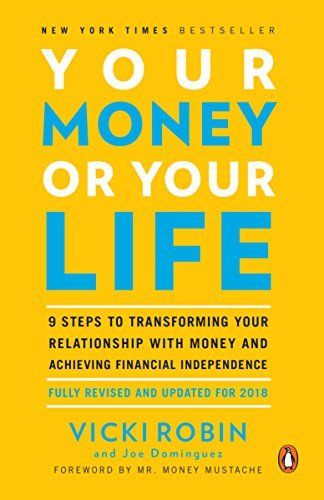
Your Money or Your Life Book Summary
Transforming Your Relationships With Money and Achieving Financial Independence
Book by Joe Dominguez, Vicki Robin
Summary
Your Money or Your Life is a transformative guide that empowers readers to redefine their relationship with money, align their spending with their values, and achieve financial independence through a nine-step program that focuses on conscious living and fulfillment rather than endless consumption.
Financial Transformation Requires Integrating All Aspects of Life
The purpose of this book is to transform your relationship with money by integrating your spending and saving with your values and purpose in life. It provides a 9-step program to help you shift from being a slave to money to being the master of it, able to think for yourself and achieve financial independence in a meaningful way. The program is about healing the split between your money and your life, so that life becomes one integrated whole.
Section: 1, Chapter: 1
Money is Something You Trade Your Life Energy For
“Money is something you trade your life energy for. You sell your time for money. It doesn’t matter that Ned over there sells his time for a hundred dollars and you sell yours for twenty dollars an hour. Ned’s money is irrelevant to you. The only real asset you have is your time. The hours of your life.”
Section: 1, Chapter: 1
Making a Dying Versus Making a Living
For many people, work has become "making a dying" rather than "making a living." Signs you might be making a dying:
- Spending most waking hours at a job that drains your energy
- Trying to relieve job stress in unhealthy ways during off-hours
- Caught in a "work-spend" cycle to maintain a lifestyle you think your job/status requires
- Defining yourself by your job title and salary rather than who you are
When work consumes so much of your precious life energy but provides little joy or meaning in return, that's making a dying, not a living.
Section: 1, Chapter: 1
Fulfillment Curve Shows Optimal Amount of Stuff for Happiness
The Fulfillment Curve is a graph showing the relationship between the experience of fulfillment and the amount of money spent. It reveals there is an optimal amount of stuff - "enough" - that maximizes fulfillment. Less than enough feels like deprivation. But more than enough leads to clutter and a drop in fulfillment.
The peak of the curve, where fulfillment is highest, is the sweet spot of "enough." Knowing what "enough" is for you frees you from excess and burden. But consumer culture pushes "more is better," so we often miss the "enough" point, going straight from "not enough" to "too much."
Section: 1, Chapter: 1
Never Having Enough
“If you live for having it all, what you have is never enough.”
Section: 1, Chapter: 1
"Gazingus Pins" are Clutter Temptations that Don't Bring Fulfillment
"Gazingus pins" are any items you feel compelled to buy whenever you see them, even though you likely have a drawer full of them already. They're clutter in the making - that brief shopping high masking a lack of true fulfillment.
Start noticing your own gazingus pins. Catch yourself in a store reaching zombie-like for something you don't need. Connect the dots between accumulating more of these and declining happiness. Then visualize that junk drawer exploding! This heightened awareness of the letdown of gazingus pins compared to the real joys of life helps release their grip.
Section: 1, Chapter: 1
Money Equals Something We Trade Life Energy For
The authors present a new definition of money to transform our relationship with it: Money is something we choose to trade our life energy for. Our life energy is all the hours of precious, limited time we have on Earth. So whenever we work for money, we are trading hours of our life.
This definition puts the focus on what money really costs us - our very life force. It prompts the question: Is this expense worth the hours of my finite life required to pay for it? With this awareness, we can start making more conscious choices aligned with our true values.
Section: 1, Chapter: 2
Calculating Your Real Hourly Wage Reveals Job's True Costs
To determine what you're really trading your life energy for, calculate your real hourly wage:
- Add up all job-related expenses like commuting, work clothing, decompression activities, etc.
- Add these costs to your official work hours to get your real work hours.
- Subtract taxes and job costs from your salary to get your real earnings.
- Divide real earnings by real hours to get your real hourly wage.
The result is often shockingly lower than your official salary. Knowing this allows you to see clearly whether a job is worth it or if it's time for a change.
Section: 1, Chapter: 2
Budgets Don't Work, Tracking Does
Budgets, like diets, tend to fail because they try to force your behavior into preset categories based on how things "should" be. They focus on external rules rather than helping you change your internal relationship with money.
What does work is awareness gained through tracking - writing down every cent that comes into or goes out of your life. This is not deprivation but conscious spending. You get an accurate picture of your habits and can spot patterns to change - not overnight, but gradually and permanently as awareness grows. You put quality of life ahead of quantity of dollars.
Section: 1, Chapter: 3
How to Do a Monthly Tabulation and Convert Dollars to Life Energy
At the end of each month, follow these steps to heighten awareness of how your earning and spending align with your life:
- Create categories for all expenses, being as specific as needed to spot patterns. Include subcategories as useful (e.g. under Clothing: Work Clothes, Leisure, Gazingus Pins).
- Enter all income and expenses in appropriate categories.
- Total each category.
- For each total, divide by your real hourly wage to get hours of life energy spent.
- Notice which categories are worth the life energy and which aren't.
Translate dollars into life energy repeatedly to make that your new metric for financial choices. Let the awareness itself change you over time.
Section: 1, Chapter: 3
Related Content
Die With Zero Book Summary
Bill Perkins
Die with Zero is an unconventional guide that challenges traditional notions of saving and spending, urging readers to maximize their life experiences by investing in memories and relationships while they still have the time and health to fully enjoy them.
Die with Zero is an unconventional guide that challenges traditional notions of saving and spending, urging readers to maximize their life experiences by investing in memories and relationships while they still have the time and health to fully enjoy them.
Life
Meaning
Money
The Psychology of Money Book Summary
Morgan Housel
The Psychology of Money is a fascinating look at the strange ways people think about money and teaches you how to make better sense of one of life's most important topics. Doing well with money isn't necessarily about what you know; it's about how you behave, and behavior is hard to teach, even to really smart people.
The Psychology of Money is a fascinating look at the strange ways people think about money and teaches you how to make better sense of one of life's most important topics. Doing well with money isn't necessarily about what you know; it's about how you behave, and behavior is hard to teach, even to really smart people.
Psychology
Money
Self-Help