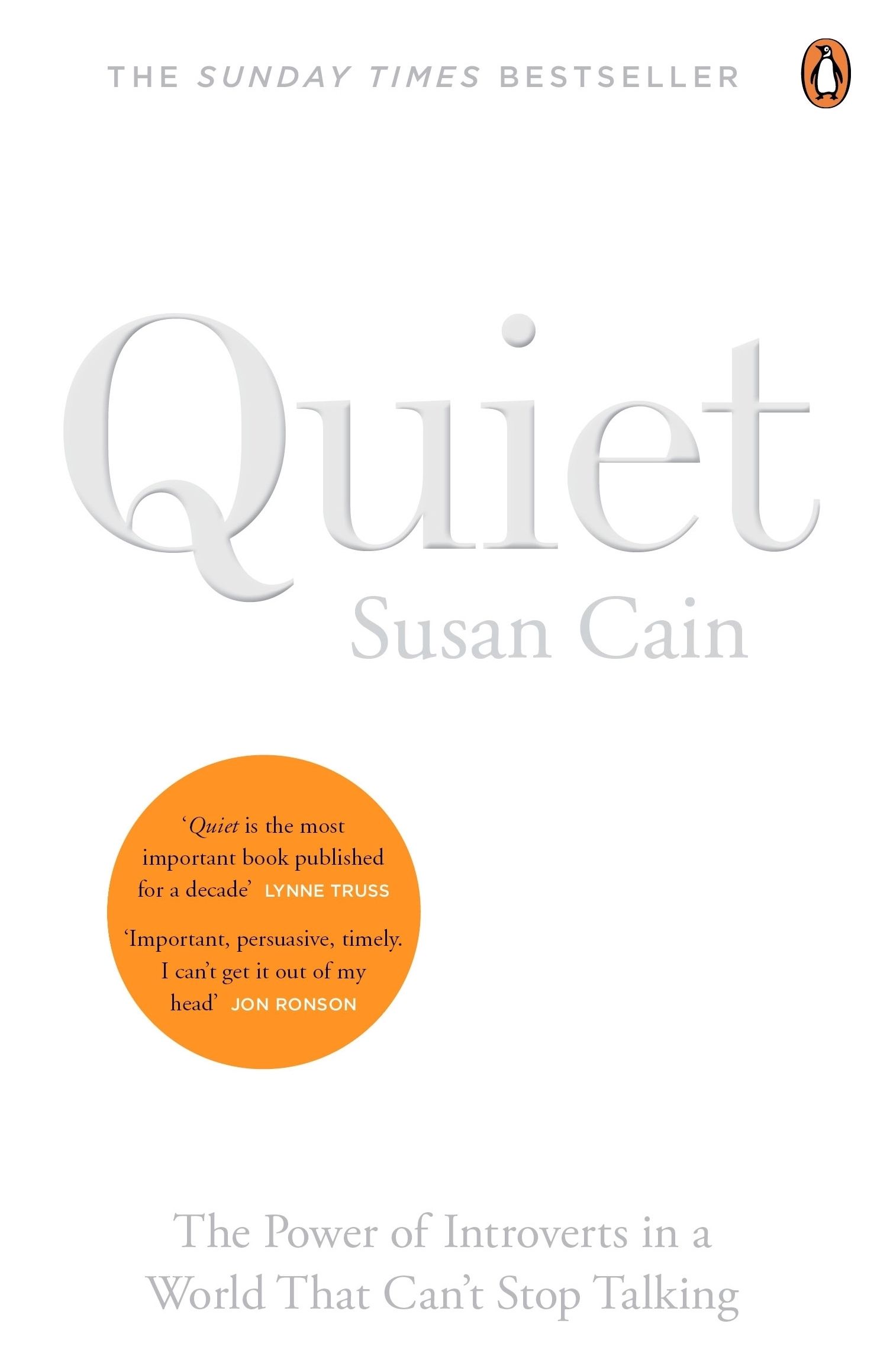
Quiet Book Summary
The Power of Introverts in a World That Can't Stop Talking
Book by Susan Cain
Feeling Lazy?Read 1 Minute Summary
Summary
"Quiet" explores how the Extrovert Ideal became the cultural norm in the 20th century, explores the often undervalued strengths of introverts, and argues that we need a greater balance of both personality types to thrive in work, relationships, and society as a whole.
1. The Extrovert Ideal
The Rise Of The Extrovert Ideal
In the early 20th century, America shifted from a Culture of Character to a Culture of Personality. While 19th century self-help guides emphasized moral integrity, the new advice manuals focused on charming others through force of personality. The rise of big business, urbanization, mass immigration and advertising fueled this cultural evolution. Suddenly, people were interacting with more strangers and having to prove themselves quickly. Being bold, entertaining, and social became prized over being serious, disciplined, and honorable.
Section: 1, Chapter: 1
We Like To Think We Value Individuality
"We tend to think that we value individuality, but all too often we admire one type of individual—the kind who's comfortable 'putting himself out there.' We like to think that we value individuality, but all too often we admire one narrow type. The pundits and politicians we hear from most are classic extroverts. Movie stars and news anchors smile and chat in front of cameras. We call for positive thinking and 'getting out there.' We admire to-do lists, measurable goals, and five-year plans."
Section: 1, Chapter: 1
Extroversion As A Cultural Ideal
The Extrovert Ideal is a distinctly American and Western phenomenon. Many other cultures, especially in Asia, value traits like silence, restraint, humility and sensitivity. Anthropologist C.A. Valentine noted that Western culture contains an "old, widespread, and persistent" notion of individual variability in which one is either a practical, sociable "man of action" or a unsocial, impractical dreamer. So the seeds of the extrovert-introvert dichotomy have been present for a long time. But it wasn't until the 20th century that extroversion became the unequivocal ideal.
Section: 1, Chapter: 1
Overvaluing Confidence, Undervaluing Competence
Several studies show that talkative people, even when they have nothing to say, are often perceived as smarter and better looking than quiet types. Fast talkers are rated as more capable and likable than slow talkers.
The same biases exist in group settings, where research shows that the voluble are seen as smarter than the reticent, even though there is no actual correlation between verbal output and intelligence. There are serious consequences to this bias towards talkativeness. People who talk a lot in a confident manner tend to do better in school and get higher ratings from their teachers, even when their actual knowledge is no greater. Similarly, a "good" job interview often has little relationship with job performance.
This is not to say that social skills are unimportant. But when people unconsciously conflate talkativeness with capability, there are dangers. We may fail to recognize ability where it counts. And we create a culture where people feel pressure to talk and act forcefully even when they have nothing of substance to say.
Section: 1, Chapter: 1
The Orchid Hypothesis
A groundbreaking theory called "the orchid hypothesis" suggests that many people are like "dandelions" that can thrive in any environment. But others are more like "orchids"—they wilt easily, but under right conditions can grow strong and magnificent.
Highly-reactive, sensitive kids fit the orchid analogy. They're more vulnerable to bad environments, but they also thrive in good environments even more than resilient, dandelion children. Research shows that not only are sensitive children NOT doomed to lives of anxiety, but that they can actually outshine their peers in supportive, nurturing circumstances.
So rather than seeing sensitive, introverted kids as fragile, parents should recognize that their kids may be unusually capable of flourishing—as long as they get the right inputs. Yes, such children need extra nurturing and protection. But that extra care can produce exceptional results.
Section: 1, Chapter: 3
The Myth Of Charismatic Leadership
Jim Collins, the influential management theorist, analyzed the leadership styles of eleven standout companies. He was surprised to find that all were led by low-key, unassuming CEOs. These leaders were more likely to listen carefully, motivate through quiet encouragement, and have a penchant for thoughtfully assessing problems:
- Introverted leaders often deliver better outcomes than extroverts, especially when managing proactive employees
- Extroverted leaders can be so intent on putting their stamp on things that they risk losing others' good ideas
- Many effective leaders are private, cerebral types who shun the spotlight
The "extroverted charismatic" leadership style is not always as effective as pop culture suggests. In fact, organizational psychologist Adam Grant found that introverted leaders often outperform extroverts in certain situations because they're less threatened by others' input.
Section: 1, Chapter: 2
Solitude Is Crucial For Creativity
Brainstorming sessions and groupthink are popular, but solitude is very important for creative work. Research shows that performance gets worse as group size increases. Many people believe that creativity comes from gregarious exchanges of ideas, but in reality, people are most creative when they enjoy privacy and freedom from interruption.
Open-plan offices have been found to reduce employee productivity and impair memory. They make people sick, hostile, unmotivated, and insecure. What most people really need to be most effective is more privacy, Even in fields that we assume rely on face-to-face collaboration, like computer programming, individuals tend to be most innovative when they're allowed to work alone.
Some of the most spectacularly creative people in history produced their best work in solitude, from novelists to mathematicians to musical composers. They relish the opportunity to dive into a project for hours or days at a time - uninterrupted, they can achieve true depth of thought.
Section: 1, Chapter: 3
2. Your Biology, Your Self?
3. Do All Cultures Have an Extrovert Deal
4. How to Love, How to Work
Related Content
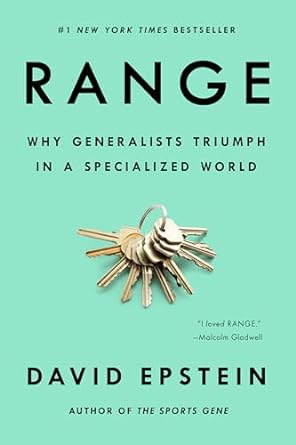
Range Book Summary
David Epstein
"Range" challenges the conventional wisdom that early specialization is the key to success. Instead, Epstein argues that in our increasingly complex and unpredictable world, it is those with broad experience and diverse skills who are best equipped to thrive.
"Range" challenges the conventional wisdom that early specialization is the key to success. Instead, Epstein argues that in our increasingly complex and unpredictable world, it is those with broad experience and diverse skills who are best equipped to thrive.
Personal Development
Learning
Psychology

The Anxious Generation Book Summary
Jonathan Haidt
In The Anxious Generation, Jonathan Haidt traces the sudden rise of teen anxiety, depression, and self-harm to the simultaneous decline of free play and rise of smartphones. Haidt shows how restoring the pillars of a play-based childhood may be the key to reversing the mental health crisis engulfing Gen Z.
In The Anxious Generation, Jonathan Haidt traces the sudden rise of teen anxiety, depression, and self-harm to the simultaneous decline of free play and rise of smartphones. Haidt shows how restoring the pillars of a play-based childhood may be the key to reversing the mental health crisis engulfing Gen Z.
Psychology
Mental Health