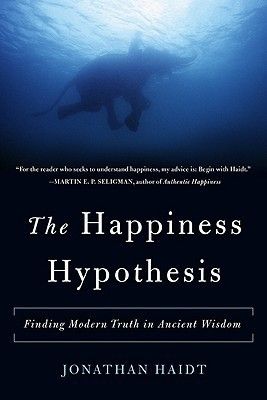
The Happiness Hypothesis Book Summary
Finding Modern Truth in Ancient Wisdom
Book by Jonathan Haidt
Summary
The Happiness Hypothesis is a thought-provoking exploration of ancient wisdom and modern science that reveals the true sources of human flourishing - love, work, virtue, and the harmony between our divided selves and our social world.
The Mind Is Divided Into Separate Parts That Often Conflict
Haidt explains that the human mind is divided in many ways that can lead to internal conflicts. The main division discussed is between the conscious/reasoned processes and the automatic/implicit processes. He uses the metaphor of a rider (controlled processes) on an elephant (automatic processes) to illustrate that the rider often struggles to control the much larger and more powerful elephant. While the rider can try to guide the elephant, ultimately the elephant determines most of our behavior.
Section: 1, Chapter: 1
Our Minds Are Divided In Four Main Ways
The four main divisions of the mind discussed are:
- Mind vs Body - Different parts of the body, like the gut, have their own "minds" that function separately from the brain
- Left brain vs Right brain - The two brain hemispheres have specialized functions
- New brain vs Old brain - Evolutionary newer brain regions sometimes conflict with older regions
- Controlled vs Automatic processes - Conscious controlled processes are limited, while automatic processes handle most of our behavior
Section: 1, Chapter: 1
The Rider Evolved To Serve The Elephant
Haidt argues that while language and reasoning skills (the rider) evolved relatively recently, automatic processes and emotions (the elephant) have been evolving for hundreds of millions of years to quickly respond to our environment. The rider therefore did not evolve to be in total command, but rather to work together with and serve the elephant's needs. The rider provides some guidance but is mostly just an advisor to the elephant.
Section: 1, Chapter: 1
Thinking Changes How We Perceive Things
The main idea of this chapter is captured well in two quotes - one from Shakespeare that "There is nothing either good or bad, but thinking makes it so", and one from Buddha that "Our life is the creation of our mind." In other words, while we cannot always control what happens to us externally, to a large extent our experience of life depends on how we interpret and react to events mentally. This is a core tenet of Cognitive Behavioral Therapy.
Section: 1, Chapter: 2
Techniques For Retraining The Elephant To Be More Positive
Haidt describes three main methods for shifting one's automatic patterns of thinking in a more positive direction:
- Meditation - Practicing focused attention weakens attachments and provides distance from one's normal train of thought, allowing negative patterns to be recognized and disengaged from
- Cognitive therapy - Systematically catching, labelling and challenging negative thoughts and cognitive distortions to develop more balanced thinking habits
- Prozac - Medications that act directly on neurotransmitters like serotonin to alter automatic responses, especially when therapy alone is insufficient
Section: 1, Chapter: 2
Prozac Can Be A Useful Shortcut
For people who struggle with anxiety, negativity and pessimism due to their inborn temperament (neurochemistry), Haidt believes Prozac and similar antidepressants can be a legitimate shortcut to a healthier mood baseline. While the ideal may be to change one's thinking habits directly through therapy, this is very difficult for some people. Responsible use of medication combined with therapy and other healthy habits can make real change possible that would otherwise be out of reach. It provides a stepping stone to implementing other positive practices.
Section: 1, Chapter: 2
The Rule Of Reciprocity Is The Basic Currency Of Social Life
Reciprocity, or paying back what others do to you (good or bad), is a human universal found in all cultures. It allows for cooperation between individuals who are not related. The tit-for-tat strategy - being nice until provoked, but then retaliating if wronged - tends to lead to the best long-term outcomes in social interactions. Behaviors like gratitude and vengeance exist to reinforce and motivate adherence to reciprocity.
In addition to gratitude and vengeance between two interacting individuals, gossip is a mechanism that promotes reciprocity and cooperation on a larger societal scale. Language may have evolved primarily to facilitate gossip - allowing people to keep track of who is doing what to whom, so cheaters can be punished and cooperators rewarded, even by those not directly involved. Gossip extends reciprocity beyond direct dyads.
Section: 1, Chapter: 3
Salespeople Exploit The Rule Of Reciprocity To Influence Customers
Haidt gives the example of Hare Krishna followers who would forcefully give flowers to passersby and then request donations. Most people, having accepted the small gift, would feel obligated to give something back in return. Salespeople use similar techniques like free samples or gifts to invoke an obligation in customers through the reciprocity principle. One must actively resist these influence attempts once recognized.
Section: 1, Chapter: 3
Balance Giving And Taking In Relationships
In personal relationships, especially new ones like dating, there is a delicate balance to maintain in terms of reciprocity. Giving too much too soon may come across as desperate, while giving too little seems aloof and uncaring. The relationship develops best with matched and escalating exchanges of giving, sharing and vulnerability. This back-and-forth builds trust and liking. Try to match the other person's pace and level of sharing.
Section: 1, Chapter: 3
We Suffer From A "Myth Of Pure Evil" When Judging Others
Haidt argues that people have a tendency to view those they disagree with as purely evil, rather than recognizing the complex motivations and situational factors that drive most human behavior. We readily see the faults in others but struggle to recognize our own biases and hypocrisies. This myth of pure evil leads to unnecessary hostility and conflict between individuals and groups. In reality, very few people are deliberately malicious - most believe that their actions are justified.
Section: 1, Chapter: 4
Our Biased Perceptions Make It Very Difficult To See Our Own Faults
Several cognitive biases contribute to people's inability to see their own faults while readily seeing them in others:
- The Bias Blind Spot - We see others' judgments as biased but not our own
- Naive Realism - We believe we see objective reality and that reasonable people will agree with us
- Cognitive Dissonance - We deny or rationalize facts that conflict with our self-image as a good person
- Confirmation Bias - We seek information that supports our existing beliefs and ignore contrary evidence
Because of these powerful self-serving biases, it is very difficult to recognize our own moral failings and hypocrisies.
Section: 1, Chapter: 4
Finding Your Own Faults Is The Key To Escaping Hypocrisy
Most people readily see the faults and biases of others, but have a very difficult time recognizing those same faults in themselves due to self-serving biases. The only reliable way to avoid self-righteousness and hypocrisy is to actively search for your own faults and contributions to conflicts.
When you find even minor ways that you acted poorly or hypocritically, it becomes much easier to forgive the faults of others and reconcile differences. Seeing your own role in conflicts also short-circuits anger and makes empathy possible. Make a habit of searching for your own faults, however small, rather than focusing on the obvious faults of others.
Section: 1, Chapter: 4
Myths And Misconceptions About What Makes People Lastingly Happy
Haidt debunks several popular myths about happiness, such as:
- Achieving major life goals like wealth, beauty, or prestige will make you lastingly happier
- Getting what you want always makes you happier
- Happiness comes either only from within (internal) or only from without (external)
- Following your gut desires and feelings will make you happy
In fact, research shows that most external conditions have a surprisingly minor impact on long-term happiness levels. Many apparent goods are subject to hedonic adaptation, fading quickly. The clearest external predictors of happiness are strong relationships, meaningful work, and connection to something greater than oneself.
Section: 1, Chapter: 5
Related Content
Stumbling on Happiness Book Summary
Daniel Gilbert
Harvard psychologist Daniel Gilbert takes readers on a whirlwind tour of the human brain, exploring how our unique ability to imagine the future often leads us astray in predicting what will make us happy. Gilbert argues that the futures we envision are often distorted by our current emotions, our flawed memories, and our psychological blind spots - but recognizing these limitations, we can learn to more accurately forecast our feelings and maximize our well-being.
Harvard psychologist Daniel Gilbert takes readers on a whirlwind tour of the human brain, exploring how our unique ability to imagine the future often leads us astray in predicting what will make us happy. Gilbert argues that the futures we envision are often distorted by our current emotions, our flawed memories, and our psychological blind spots - but recognizing these limitations, we can learn to more accurately forecast our feelings and maximize our well-being.
Happiness
Psychology

The Anxious Generation Book Summary
Jonathan Haidt
In The Anxious Generation, Jonathan Haidt traces the sudden rise of teen anxiety, depression, and self-harm to the simultaneous decline of free play and rise of smartphones. Haidt shows how restoring the pillars of a play-based childhood may be the key to reversing the mental health crisis engulfing Gen Z.
In The Anxious Generation, Jonathan Haidt traces the sudden rise of teen anxiety, depression, and self-harm to the simultaneous decline of free play and rise of smartphones. Haidt shows how restoring the pillars of a play-based childhood may be the key to reversing the mental health crisis engulfing Gen Z.
Psychology
Mental Health